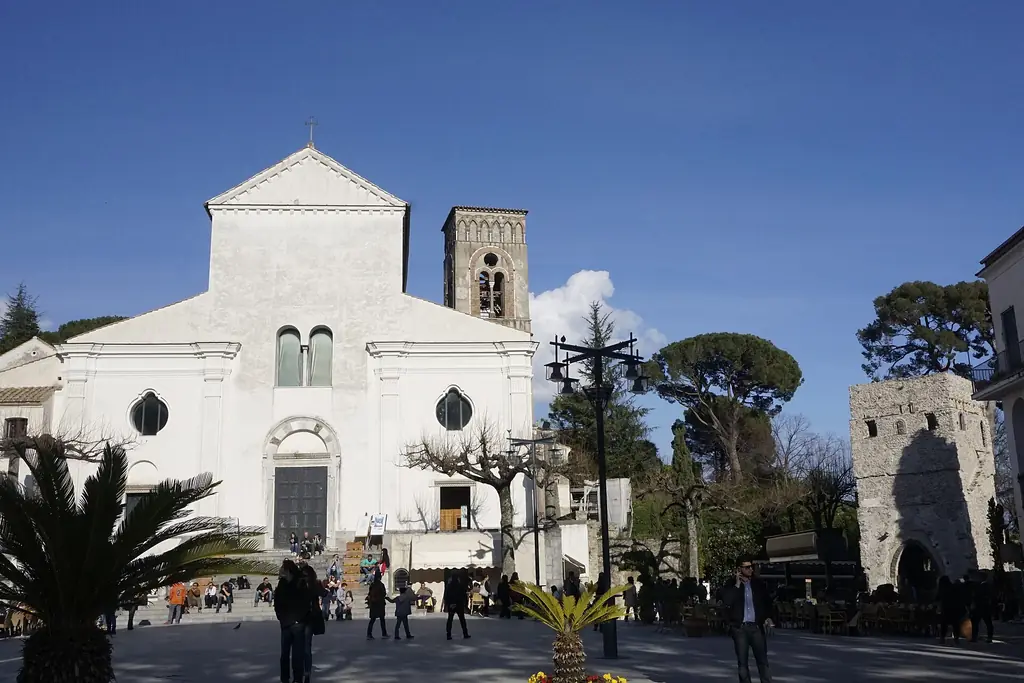
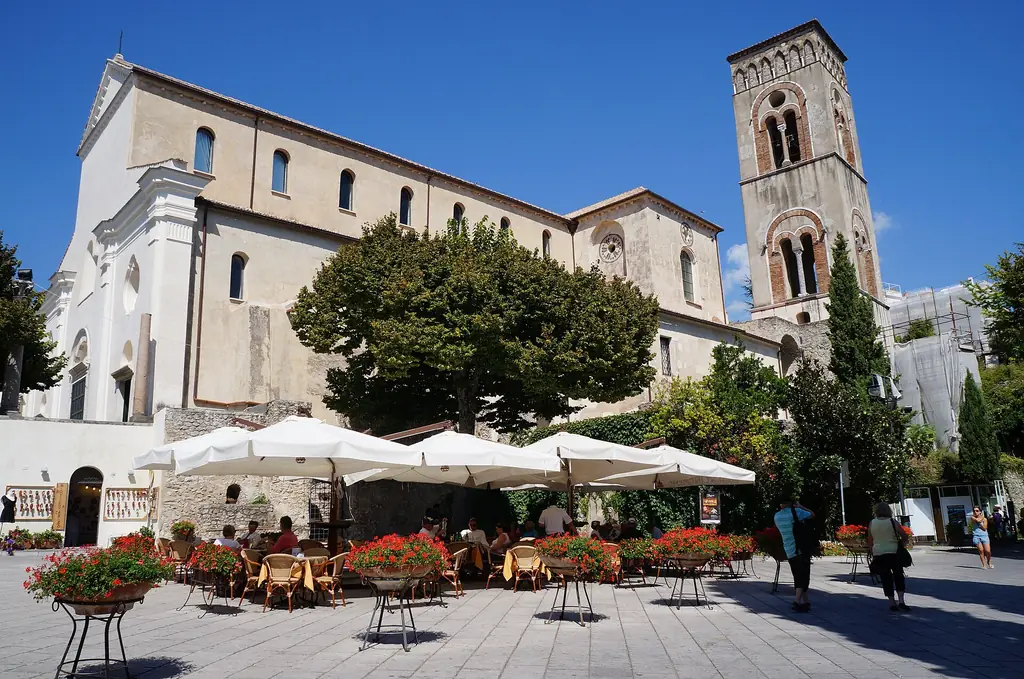
Most people photograph the bell tower from a café table and move on to Villa Rufolo next door. That is a pity: the Duomo of Ravello takes half an hour to see properly and helps explain the town's history. Here is what to look for, in the order you will meet it.
Nine centuries in one church
Building began in 1086, the year Ravello became a bishop's seat. The church is dedicated to Santa Maria Assunta and to San Pantaleone, the patron saint of the town. The facade was remade in the 16th century, and later a Baroque makeover covered the medieval interior. Restoration work in the second half of the 20th century took much of that away again, so what you see today is a reconstruction of the Romanesque church, with bare columns and a timber roof.
Ravello is no longer a diocese, so officially this is a former cathedral. Everyone in town still calls it the Duomo, and it gives its name to the square in front.
The bronze doors of 1179
The central door is the main thing to see. It was cast in 1179 by Barisano da Trani and paid for by a local nobleman, Sergio Muscettola, whose gift is recorded in an inscription on one of the panels. There are 54 panels in all, with scenes of the Passion, saints and two decorative masks. Barisano also signed the bronze doors of the cathedrals of Trani and Monreale, and Ravello's door is counted among his most important works. It returned to Ravello after a careful restoration presented in 2013.
Two pulpits facing each other
Inside, two medieval pulpits stand on opposite sides of the nave, and it is worth comparing them.
- The ambo of the Epistle is the older one, from the 12th century. Its green and gold mosaics tell the story of Jonah, swallowed by the whale and then spat out again: an image of the Resurrection.
- The pulpit of the Gospel, made in 1272 by Nicola di Bartolomeo da Foggia and donated by Nicola Rufolo, the man who built Villa Rufolo. Its marble box rests on six columns standing on lions, with twisted columns at the corners, and it is covered in mosaics of plants and fantastic animals.
Together they show how much money and taste the merchant families of Ravello had in the 12th and 13th centuries.
The chapel of San Pantaleone
To the left of the main altar, a chapel built in 1643 holds the relic of San Pantaleone. His feast day is 27 July. If you are in town that week, expect the Duomo to be at the centre of the celebrations.
The museum in the crypt
The Museo del Duomo was created in 1983 in the crypt, a low hall of granite columns and cross vaults. Its best known piece is a marble bust of a woman made in 1272, traditionally identified as Sigilgaida Rufolo, wife of Nicola Rufolo, and attributed to Nicola di Bartolomeo da Foggia. Some scholars see the Virgin or a queen of Naples in it instead. The museum also keeps sculpture and objects from the church treasury.
The museum has its own entrance and a small ticket. Its hours do not always match those of the church.
Visiting tips
- Allow 30 to 45 minutes for the church and the museum together.
- Visits stop during services, so avoid Sunday mornings.
- Cover shoulders and knees, as in any Italian church.
- Combine it with Villa Rufolo, whose entrance tower is a few steps away on the same square, and read the short history of Ravello to put the Rufolo family in context.
- Opening hours and ticket prices change with the season: check them on site or with the official sources below.
Questions
When was Ravello Cathedral built?
Construction began in 1086, when Ravello became a bishop's seat. The facade dates from the 16th century and the interior was restored to its Romanesque look in the 20th century.
Who made the bronze doors of Ravello Cathedral?
Barisano da Trani cast them in 1179. They were donated by the Ravello nobleman Sergio Muscettola and have 54 panels.
Is there a museum in Ravello Cathedral?
Yes. The Museo del Duomo, opened in 1983 in the crypt, has a separate entrance and a small ticket. Its best known piece is the 13th century bust traditionally identified as Sigilgaida Rufolo.
When is the feast of San Pantaleone in Ravello?
On 27 July. The relic of the saint, patron of Ravello, is kept in a chapel of the Duomo built in 1643.